This piece is the first in a series of works I started actively thinking about some two or three years ago. Although I had a very clear idea of what I wanted this series to mean, it took a lot of time for me to ruminate on how I wanted the paintings to look. Without ever putting pencil to paper, I have been thinking, and even dreaming about this series, and it has gradually become clearer in my mind. This is only an initial and very small-scale exploration of what I am convinced will become my next great body of work.
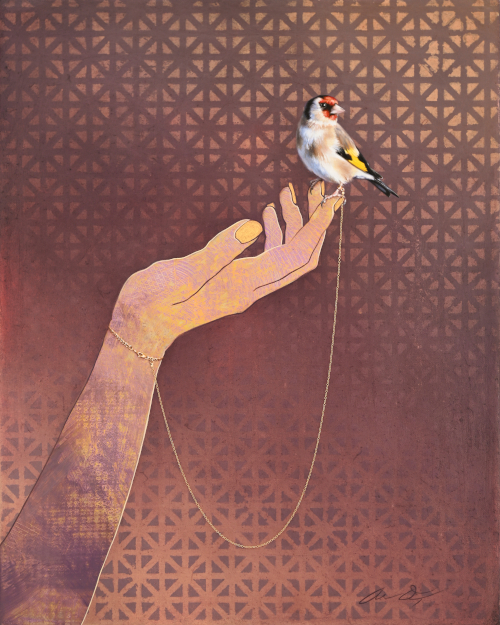
“Psychopomp” is a term from Greek mythology, describing an entity, often a bird, that escorts newly deceased souls to the afterlife, but the concept transcends many cultures around the world. It makes perfect sense for birds, which straddle both land and sky, the be intermediaries between planes of existence. Traditionally it is crows, ravens, swallows, sparrows, and nightjars that play this role, but I have used a European Goldfinch, alluding to Dutch artist Carel Fabritius’s famous painting of a similarly tethered Goldfinch from 1654. The Goldfinch is a common symbol of redemption in Medieval Christian Art, especially depictions of the Madonna, where the red forehead presages the crucifixion (the belief being that this marking resulted from the bird’s attempt to remove the crown of thorns and being stained with Christ’s blood in the process).
Whether the afterlife brings redemption, nothingness, reward, punishment, or some adventure of which we cannot conceive, I have always been preoccupied with the specter of death. It is a subject I have approached in my work many times over the decades, most often with a sense of poignance, be that reverential paintings of dead birds or symbolic still lifes dialoguing with the American Trompe-l’oeil painters of the late 1800’s and early 1900’s, especially their Vanitas paintings. The Vanitas (Latin for vanity) are still life paintings in which the objects are symbolic of the transitory nature of life and the futility (indeed vanity) of human ambition in the face of impending death. There is a beautiful irony to these paintings in that they do physically persist as objects themselves, and have thus given their creators something very like immortality.
In my painting, the ephemerality of all human existence is symbolized by the 1mm gold chain connecting the bird to the human wrist. The chain encircling the wrist is painted in hyper-realistic Trompe-l’oeil detail, but it was important to me that the chain between hand and bird be a real chain affixed to the painting at only two points. It is literally, and quite deliberately, fragile. We are all bound to this world by the thinnest of threads.
 <
<